
19.11.2025
Uncategorized
“Blinding and Burning”: The Times Reports on Katran Maritime Drones
Journalists from The Times arrived in Ukraine to witness the work of Katran maritime drones firsthand and meet the people who have already entered modern military history.
In September, Ukraine's Main Directorate of Intelligence conducted a multi-stage operation in the Black Sea. Using Magura and Katran drones, the military attacked Russian gas platforms. While the operation remained secret for a time, its details have now been revealed to The Times.
The occupiers used the oil platforms to house personnel and powerful radar and electronic warfare systems, allowing them to control the Black Sea waters up to Ukraine's southern coast and temporarily shielding Russian territory from sea attacks.
However, Ukrainian special forces took this “trump card” away. The GUR mission involved surface and underwater drones, as well as FPV and fixed-wing kamikaze drones, reports The Times. Such a comprehensive operation indicates Ukraine's shift toward revolutionary high-tech battlefield solutions.
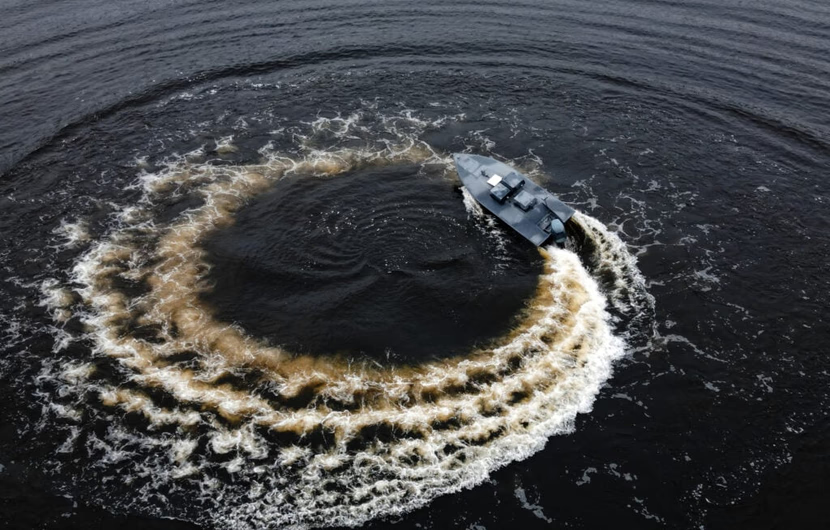
Katran Maritime Drone / Photo by The Times
The operation began on the night of September 21. Katran X1 and X3 maritime drones acted first, carrying nine FPV drones and four fixed-wing drones. Additionally, each Katran carried underwater kamikaze drones—so-called long-range “smart torpedoes” with an 80kg warhead—suspended under the hull. Knowing that Su-27 and Su-35 jets were on duty, the scouts first diverted enemy aviation with a decoy. Meanwhile, the armed Katrans made a 100km loop to approach the gas rigs from the opposite side.
“The first guided underwater torpedo hit the platform support, causing soldiers to scramble out. Then the second torpedo hit. We neutralized the radar systems using the fixed-wing drones,” says 'Ninth,' a special forces operator from the GUR FERRATA unit.
Following this, the Katran drones successfully returned to base, while Magura strike drones sped through the opened corridor to attack an oil depot in Novorossiysk. On the same day, other units destroyed a 'Nebo-U' radar in occupied Crimea using aerial drones.

Russian Platform under attack by Ukrainian forces / Image by GUR MO
“We conducted a successful sabotage operation that allowed other units to reach the ports of Crimea, Novorossiysk, and Tuapse,” says 'Ninth' regarding the September mission. He and his team are already planning the next one.
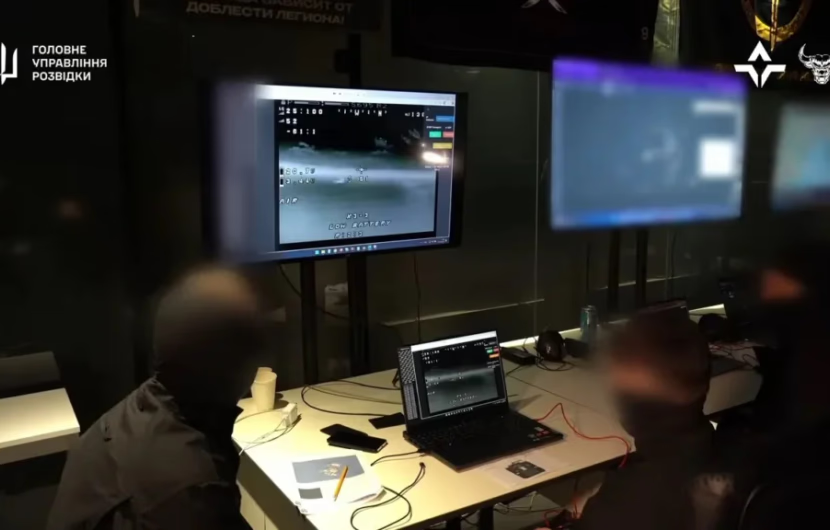
The Times journalists also observed the Katran development process—a close collaboration between professional military personnel and a tech startup. Work at the headquarters is highly coordinated: 3D printers produce new components, while engineers test 360-degree camera mounts and train AI software to visually identify targets.
During combat, operators use VR goggles to control drones and weaponry from a specially designed pilot station. It is foldable and mobile, allowing special forces to arrive secretly at any location, strike the enemy, pack up, and return to base.